
In today’s interconnected world, drugs travel continents before finally reaching the patient. Throughout this process, even a single weak link can invite falsified/sub-standard drugs. This can threaten patient safety and brand credibility, impacting their trust, a risk no one can afford. Medical supply chain transparency is crucial, and track and trace in pharma is used to mitigate this risk. India’s massive export and production volume and the global regulatory requirements require complete supply chain visibility, making it more crucial than ever for manufacturers to have medical supply chain transparency. To make this possible, GS1 standards play a pivotal role. By fostering authenticity, trust, and compliance in the supply of medical drugs/devices, they facilitate safer healthcare. In this blog, we will explore in detail the need for an efficient traceability solution and learn about the GS1 standards-based traceability model.
According to the World Health Organisation (WHO), “A counterfeit medicine is one which is deliberately and fraudulently mislabelled with respect to identity and/or source. Counterfeiting can apply to both branded and generic products, and counterfeit products may include products with the correct ingredients or with the wrong ingredients, without active ingredients, with insufficient active ingredients or with fake packaging." Consumption of counterfeit/falsified/sub-standard drugs can result in poisoning, treatment failure, or exacerbation of diseases.
To mitigate this, regulators worldwide demand serialised unique identification and effective traceability measures. For pharma companies, having medical supply chain transparency is imperative because it also helps them to -
Without robust traceability measures, the pharma supply chain will remain opaque and vulnerable, calling for correct intervention by authorities at the right time.
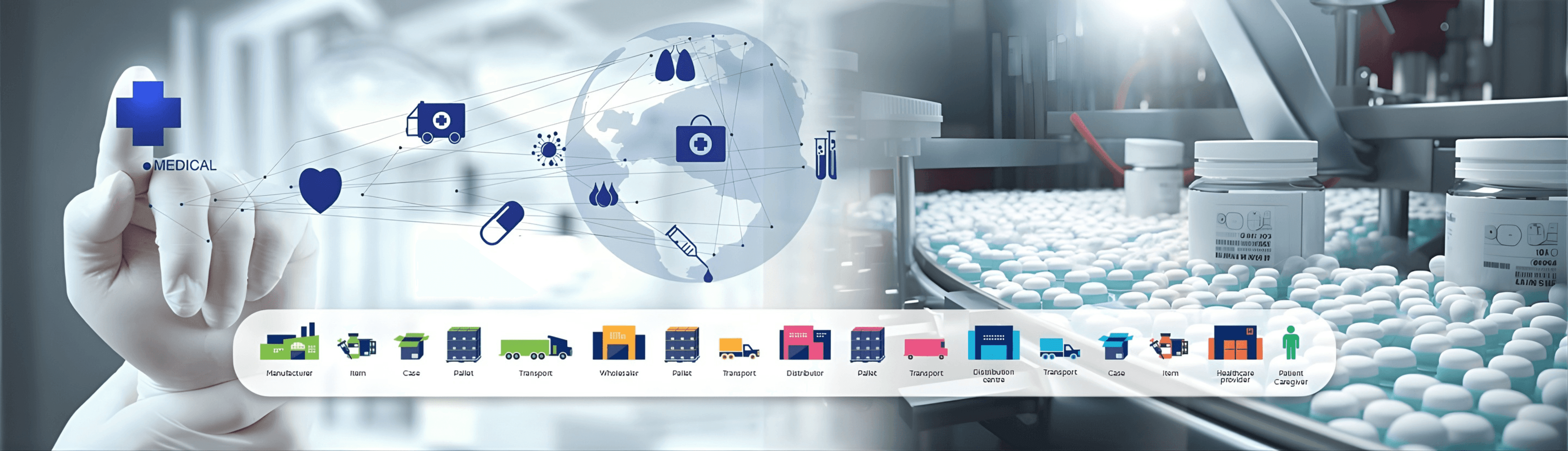
Track and Trace Pharma refers to the business processes that give companies, regulators, and patients confidence in their medical product journey. Track means capturing each point as a medicine moves through the supply chain from manufacturers, distributors, wholesalers, to dispensers. This allows organisations to see who handled the product and when.
Trace is the ability to look backwards when something goes wrong, quickly pinpointing where a specific pack came from and how it travelled, enabling targeted recalls, authentication, and protection against counterfeits.
Both capabilities rely on consistent, unique product identification. This translates to using GTINs encoded in either 1D barcodes or 2D DataMatrix codes placed on every medical unit. It allows systems across the supply chain to reference the same product in the same way.
This interoperability enables seamless data exchange and fewer manual checks. It also supports regulatory compliance and strengthens patient safety by ensuring every stakeholder/partner has the same trusted product information. Track and Trace Pharma is a coordinated, end-to-end supply chain system.
Serialized Identification - Products across primary, secondary, and tertiary level packaging are allotted serialised GTINs/SSCCs. This enables unit-level identification of each medical device/drug across the supply chain.
Data Capture - GS1 DataMatrix barcode is used by the healthcare industry for unique identification and data capture of medical devices/drugs. They are 2D barcode types, capable of storing GTIN of the product, Batch No., Lot No., Serial No., Expiry Date, and others, depending on regulatory and business requirements.
EPCIS - It is the GS1 standard for capturing and sharing event-related data across the supply chain. EPCIS enables visibility across the pharma chain by providing information on ‘what’, ‘when’, ‘where’, and ‘how’ of the products. With the presence of serialised GTINs/SSCCs encoded in 2D barcodes, EPCIS enables end-to-end traceability of healthcare products.
GS1 is the only organisation that manages and develops standards of the supply chain globally. GS1 standards of traceability and unique identification are adopted by more than 2 million companies worldwide, making them the most reliable system of traceability. Below are some benefits companies benefit from -
Being the pharmacy of the world, regulators issue several compliance mandates for healthcare organisations. The Top 300 pharma brands are now required to carry 2D barcodes to enable authentication at the Point-of-care. Upcoming frameworks are also being designed for vaccines, cancer drugs, and other high-risk categories, signalling India’s shift toward full-scale digital traceability.
Set up by the Ministry of Commerce & Industry, GS1 India enables manufacturers to generate GTINs that meet Ministry of Health, CDSCO, and global market requirements. Every Indian manufacturer receives a unique ‘890’ GS1 company prefix, ensuring product identification is globally interoperable while being recognised as originating from India. GS1 India also works closely with industry associations to support the adoption of standardised, end-to-end traceability systems across the sector.
Partnering with GS1 India ensures your pharma packaging and data systems remain compliant, interoperable, and future-ready.
Roche Diabetes Care Limited is a global leader in developing products and services for diabetes management. It has implemented an advanced serialization and traceability solution for enhancing traceability and mitigating counterfeit risks. For this, it has leveraged the combined power of GS1 DataMatrix barcode, Smart Consumer app and DataKart Trace. Read the full case study here to know how Roche strengthened its brand reputation and achieved regulatory compliance.
You can register for traceability services with GS1 India by following the steps mentioned -
Step 1: Visit GS1 India’s website - https://www.gs1india.org/
Step 2: Navigate to GS1 India’s DataKart Trace under the Services tab.
Step 3: Click ‘Register Now’ button on the banner to avail GS1 traceability services.
Step 4: Fill out the complete Trace registration form, pay the fee, and submit to begin your trace journey with GS1 India.
Track and trace pharma is the process of monitoring drug/medical device movement throughout the supply chain.
Track and trace pharma is important for the medical supply chain transparency as it helps in early mitigation and detection of counterfeits/falsified products in the market, thus strengthening customer trust and loyalty.
GS1 standards form the backbone of pharma traceability by enabling accurate data identification, capturing, and sharing at each supply chain node.
Pharmaceutical manufacturers can reach out to GS1 India to implement GS1-compliant track and trace systems.
Your email address will not be published. Required fields are marked *