
Imagine a native English speaker trying to communicate with an Arabic speaker, and both are unaware of each other’s language. The dialogue would be hilariously frustrating because of communication barriers. Now scale this to the global marketplace, where trust and effective communication form the backbone of the supply chain. In an era where products move across continents, such inefficiencies can impede operational processes. That’s where the role of GS1 comes in. GS1 creates a common language of trade by providing a harmonised system of standards for identifying, capturing, and sharing product information via barcodes. In this blog, we will explain what GS1 is, how it enables trusted data flows with barcodes, and how it strengthens global supply chain efficiency.
GS1 is a neutral, global not-for-profit organisation that brings industry leaders, government, regulators, academia, and associations together to develop and maintain standards for an efficient, interoperable, and transparent supply chain. Its journey began in 1974, when the first barcode was scanned in a Marsh Supermarket, Ohio. Currently, it has 120 Member Organisations (MOs) affiliated with it across 150+ countries. Each GS1 member organisation has its own country code. ‘890’ was allotted by GS1 as the country code to GS1 India.
GS1 provides standards for unique identification of products. This includes identification of Products, locations, shipments, documents, people, etc. By obtaining GCP from a GS1 member organisation, companies become part of the global network of over 2 million companies using GS1 standards. In the next sections we will cover how GS1 enables efficient trade with barcodes.
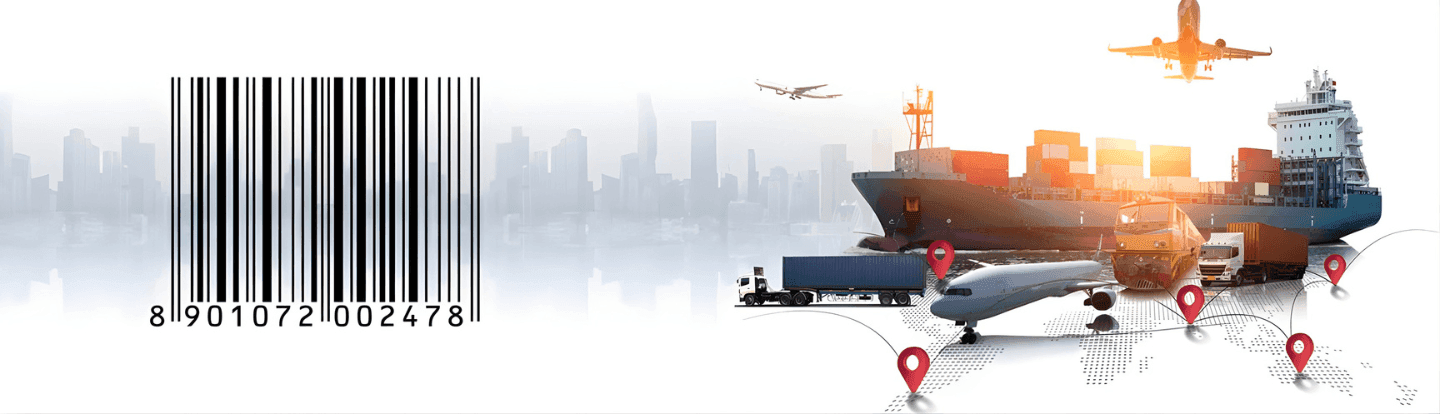
A pack of Wrigley’s gum was the first product ever to be scanned in June, 1974 using a barcode. 50 years since, today every product carries one. GS1 barcodes are data carriers that facilitate unique identification of supply chain elements. These barcodes are symbols that can be scanned electronically using a handheld or system scanner. They can be 1-dimensional (1D)/linear such as EAN, UPC, GS1-128, and ITF-14 barcodes or 2-dimensional such as QR Codes and GS1 DataMatrix. They play a key role in supply chains enabling automatic identification of products and the sharing of product information across all stakeholders.
A 1D barcode is composed of black and white parallel lines with spaces in between. It can hold a maximum of 48 alphanumeric characters. On the other hand 2D barcodes have a much larger information encoding capacity, holding up to 4296 alphanumeric characters. In addition, a 2D barcode can also encode a link to your website/product page, allowing users to access detailed product information directly from your website. Because of their advanced features, the industry has already set a date to make the transition to 2D barcodes at the point-of-sale by the end of 2027. This initiative is termed as the ‘Sunrise 2027’.
Obtaining GS1 barcodes ensures your products are globally accepted, providing you with extensive reach and strengthening your trust & authenticity in the market. When businesses build products and services around GS1 standards-based solutions they have greater confidence in their output. But how does this actually work? In the next sections we will cover the reason behind this.
GS1 standards form the backbone of a seamless, interoperable, and efficient supply chain. Their application ensures products are uniquely identified in the market and can be traced. Before GS1 was established, businesses faced chaos because of fragmented identifiers, incompatible systems, errors in manual data entry, duplicate SKUs, supply chain delays, monetary losses and more.
GS1 Standards helped businesses transition from fragmentation to global efficiency, by providing unique, global product identification. This means scanners, ERP systems, and e-commerce marketplaces know the same language. This resulted in -
GS1 India was set up in 1996 by the Ministry of Commerce and Industry along with CII, FICCI, ASSOCHAM, BIS, APEDA, IMC, FIEO, IIP, and Spices Board India. GS1 India works across multiple Indian industries including -
More than 31k companies are registered subscribers of GS1 India. By working across diverse Indian industries, GS1 India allows businesses to elevate their operations and meet global supply chain standards. Key advantages for businesses registering with GS1 India include -
The list doesn’t end. If you wish to explore in detail how GS1 barcodes and GS1 standards-based services enhance operational efficiencies, click here. Now that we understand the importance of GS1 barcodes and the role of GS1 India in enabling transparent trade, let’s discover how a business can get registered with GS1 India.
Stepping into the supply chain following a standardised approach is comfortably easy and fast; however, your journey shouldn’t end with barcode generation. That is only the first step. Here is a step-by-step approach you need to follow to get started in the world of supply chain with GS1.
A GS1 barcode encodes a Globally Unique Identification Number (GTIN) using a prefix registered to your company, ensuring global interoperability. Other barcodes lack this unique, worldwide standard.
Global retailers require them for unique product identification, accurate inventory management, regulatory complainces and brand verification to prevent product confusion and counterfeiting in their massive systems.
No, you cannot reuse the GS1 barcode for a new product. You will have to generate a new GTIN and a new barcode for a new product. You may invite legal penalties from GS1 India if you reuse an existing GS1 barcode for a new product.
Being a GS1 subscriber is recommended for all businesses in India to meet the complex trade compliances and sell goods seamlessly.
Once you have registered for barcodes with GS1 India, it can take anywhere between 7-10 days for you to receive your GCP. Once you obtain GCP you can instantly start generating GTINs.
Your email address will not be published. Required fields are marked *