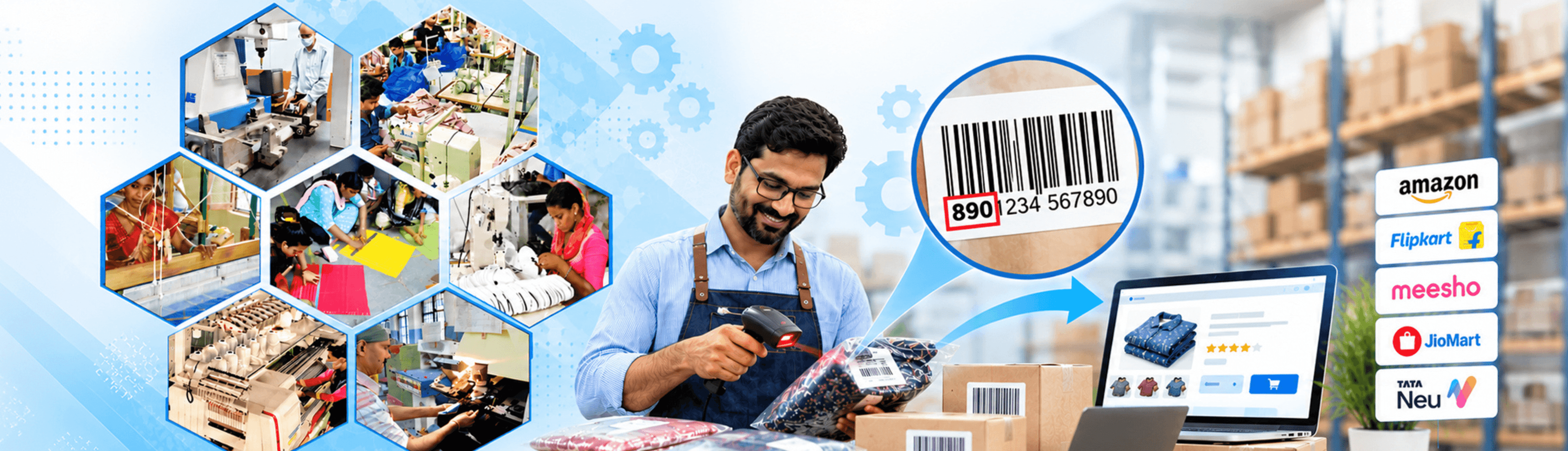

Getting a product ready for online selling involves more than creating a listing and uploading product images. When an MSME starts selling beyond local markets, it must manage product identification, listing information, inventory and dispatch requirements. If product details do not match across these processes, businesses may face listing corrections, stock confusion and delays. For smaller manufacturers working with limited budgets, correcting these issues after packaging is printed or inventory is dispatched can be expensive. GS1 barcodes help establish consistent product identification, while an important financial benefit can make registration more accessible to eligible micro-manufacturing enterprises.

A GS1 barcode represents a product identifier, usually a Global Trade Item Number (GTIN), that helps trading partners identify a specific trade item. Different pack sizes, flavours or product configurations generally require separate GTINs when they are distinct trade items.
For example, a food manufacturer selling 200-gram and 500-gram packs needs to distinguish the two products correctly. Standardised identification helps maintain consistency across product listings, warehouse records and retailer information.
These practices support supply chain solutions by giving businesses a common foundation for identifying products as they move between sellers, fulfilment centres and retail partners. GS1 India provides barcode registration services and access to product data management through DataKart.
The MSME barcode reimbursement scheme is a significant benefit for eligible micro-manufacturing enterprises registered with MSME. Introduced by the Ministry of MSME, the scheme provides up to 80% reimbursement on one-time GS1 barcode registration fees and annual recurring fees for the first three years, subject to a maximum reimbursement of ₹50,650.
The scheme applies to the 100-barcode and 1,000-barcode options and is subject to applicable guidelines. Eligibility is not automatic for every small or medium enterprise; businesses should confirm that they meet the micro-enterprise and scheme requirements.
This assistance can reduce the initial financial burden of adopting standardised product identification. Eligible businesses can review the official MSME scheme details before proceeding.
The process involves two key stages:
The MSME-DI decides whether reimbursement is approved. Businesses should review the scheme guidelines and confirm the required documentation before applying.
No. The scheme is intended for eligible micro-manufacturing enterprises registered with MSME. Applicants must meet the applicable conditions, select an eligible barcode option and follow the prescribed reimbursement process.
Eligible micro-manufacturing enterprises can claim up to 80% reimbursement on one-time registration and annual recurring fees for the first three years, subject to the scheme’s maximum limit of ₹50,650 and applicable guidelines.
The scheme covers the 100-barcode and 1,000-barcode options. Businesses should assess their current product range and likely expansion needs before registering, while confirming the applicable scheme conditions and eligibility requirements.
Applicants must submit the prescribed application to their nearest MSME Development Institute, along with the GS1 India allotment letter, invoice and payment receipt. The institute reviews the application and makes the reimbursement decision.
No. GS1 barcodes support standardised product identification, but marketplaces may have additional listing, documentation, labelling and category-specific requirements. Businesses should check the relevant platform’s current rules before publishing products.
Your email address will not be published. Required fields are marked *