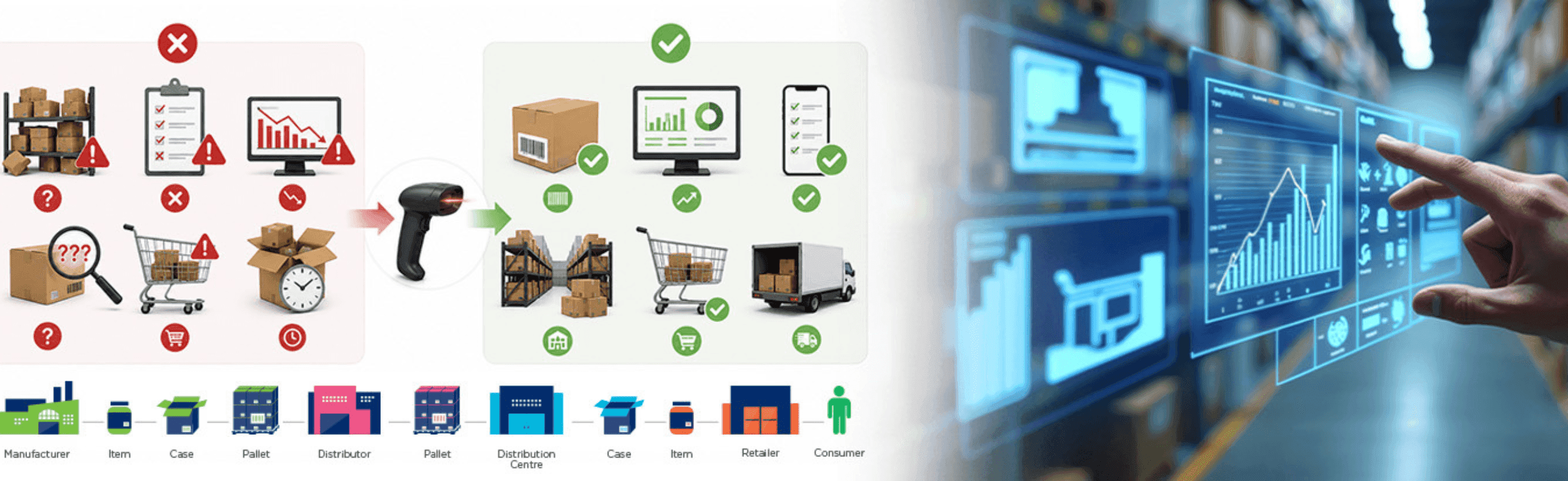

If you have ever dealt with a stockout while your system showed “in stock,” you already know the problem. Inventory management in retail and FMCG is not just about counting products. It directly affects sales, customer trust, and cash flow. One mismatch can delay orders. Multiple mismatches can impact your brand reputation. The issue may seem small, but its business impact is significant. What you see in your system often doesn’t match what is actually on the shelf. And in fast-moving categories, that gap only grows faster. This is where most businesses realise inventory is not an operations issue; it is a growth issue.

Retail and FMCG don’t deal with slow-moving products. They deal with constant movement, high SKU counts, and multiple touchpoints. That is where product identification needs to be precise, reliable, and standardised.
A few common patterns show up:
The result? You end up making decisions based on data you can not fully trust. This can lead to discrepancies between physical stock and system data, blocked orders, overstated availability, and frustrated customers.

Most inventory problems don’t start in the warehouse. They start with product identification. When every product is not uniquely identified and traceable at every stage, nothing downstream works properly. That’s where barcodes change the game.
In FMCG and retail, where speed is everything, accurate scanning is what keeps operations stable.
Not every barcode solves the problem. In fact, non-standardised codes can make things worse. The difference comes from standardisation.
Without standardisation, inventory systems keep breaking at integration points. With it, everything aligns automatically.
When barcodes are implemented properly, the change is not subtle; it is visible across the business.
What changes is not just efficiency; it is confidence in your data.

You don’t need to overhaul everything overnight. But you do need to fix the foundation.
Start here:
Once this discipline is in place, inventory stops being reactive. It becomes predictable.
It ensures the right products are available at the right time without overstocking or shortages.
They replace manual entry with scanning, reducing errors and updating stock in real time.
Yes, when standardised, they are recognised across all platforms.
Only to a limited extent. Manual systems can’t match the accuracy of scanning.
They are not. They are an investment, as they reduce long-term losses from errors to inefficiencies.
Your email address will not be published. Required fields are marked *