

Imagine you are a manufacturer or retailer with hundreds or thousands of SKUs. Without a solid system to manage product data, you face issues like inconsistent product information, mismatched specifications, duplicate SKUs, wrong barcodes, and outdated details. These errors lead to listing delays, returns, compliance problems, and lost revenue. This chaos can be avoided with Product Master Data Management (PMDM). PMDM serves as a stable, scalable data backbone, transforming disorganised data into a valuable business asset. In this blog, we will discuss why PMDM matters, its impact on businesses, and how adopting it as a core process can improve your product data handling and growth.

PMDM is a set of practices and processes designed to ensure that critical business data, like product identifiers, descriptions, and attributes, remains accurate, consistent, and governed across systems.
Product-specific MDM focuses on managing all product-related data: identifiers, specifications, packaging details, versions, images, compliance info, and more, in one centralised, unified repository.
PMDM vs. Ad-hoc Systems
Unlike fragmented systems like spreadsheets or catalogues, PMDM provides:
1. Data Silos and Fragmentation - When product data is scattered across multiple systems (e.g., ERP, logistics, marketing, e-commerce), inconsistencies and errors inevitably arise. These lead to:
PMDM centralises product data, providing one source of truth, ensuring all teams work with the same, up-to-date information.
2. Duplicate, Inconsistent, or Missing Data - Without PMDM, businesses often face:
These issues cause:
3. Inefficiency and Manual Overhead - Updating data across multiple systems manually is time-consuming, error-prone, and doesn’t scale well with growing SKUs. PMDM automates data handling and centralises updates, saving time and reducing errors.
4. Supply Chain and Market Access Risk - Without clean, consistent product data, businesses may face:
These issues can block market access, especially when exporting goods or partnering with major retailers.
5. Poor Decision-Making & Analytics -
Unreliable product data leads to inaccurate forecasting, margins, and business strategies. PMDM ensures that the data used for analytics is consistent, improving decision-making.
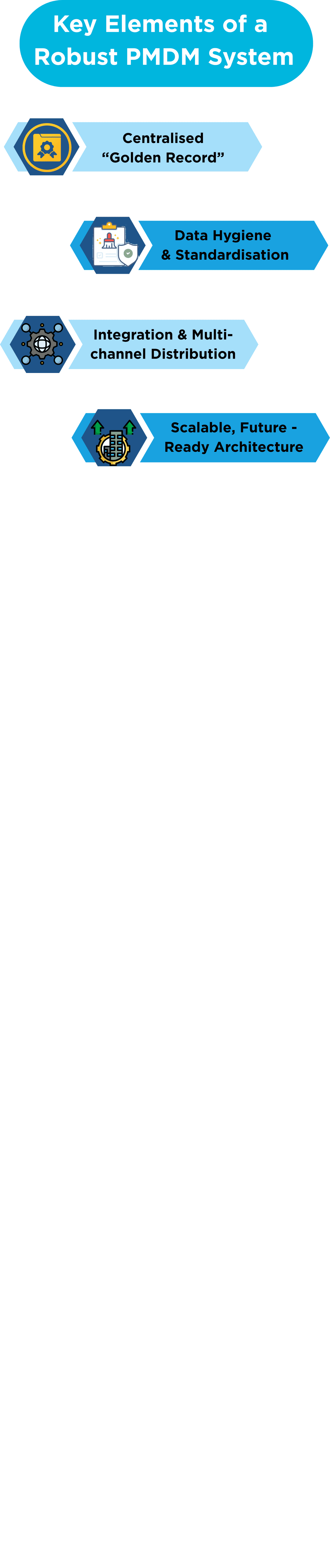
A robust PMDM system contains key components to ensure product data is accurate and well-managed across the organisation:
1. Centralised “Golden Record” -
A single, unified repository where each product and its variants are tracked. This includes:
2. Data Hygiene & Standardisation -
Automatic deduplication and data quality checks ensure:
3. Integration & Multi-channel Distribution -
PMDM enables seamless distribution of clean data across:
It ensures that all stakeholders work from the same data set, reducing errors and delays.
4. Scalable, Future-Ready Architecture -
A scalable system can handle:
This flexibility supports long-term business growth.
Adopting PMDM brings numerous benefits, enabling companies to optimise operations and enhance market access.
1. Operational Efficiency and Cost Reduction -
2. Consistency & Accuracy Across Channels -
With PMDM, product information, SKU details, specs, and compliance info remain consistent across all platforms:
This leads to fewer errors and smoother operations.
3. Faster Time-to-Market and Channel Readiness -
Clean, consistent product data speeds up market entry. Retailers and e-commerce platforms accept your SKUs faster, knowing they meet their data standards.
4. Supply Chain Visibility & Traceability -
Centralised product data improves:
When product data is standardised, businesses gain full visibility into their supply chain.
5. Regulatory Compliance & Risk Mitigation -
For regulated goods (e.g., food, pharma), PMDM ensures compliance with audits and traceability, and reduces the risk of liability issues.
6. Scalability & Growth Enablement -
As your business expands, PMDM grows with it. It supports increased SKU volumes, multi-market operations, and new product variants.
7. Better Data-driven Decisions & Analytics -
With reliable master data, businesses can make better forecasts, optimise margins, and improve overall strategic planning.
To implement PMDM successfully, follow these steps:

Product master data includes identifiers, descriptions, specifications, packaging details, and compliance information.
Product master data focuses on the core product information, while transactional data relates to sales, inventory, and pricing.
Yes, you will need a centralised system or platform to manage product data effectively.
Master data should be reviewed and updated regularly to reflect changes in product specifications, regulatory requirements, and market conditions.
Small businesses can benefit greatly from PMDM as it streamlines operations, reduces errors, and supports growth.
Your email address will not be published. Required fields are marked *