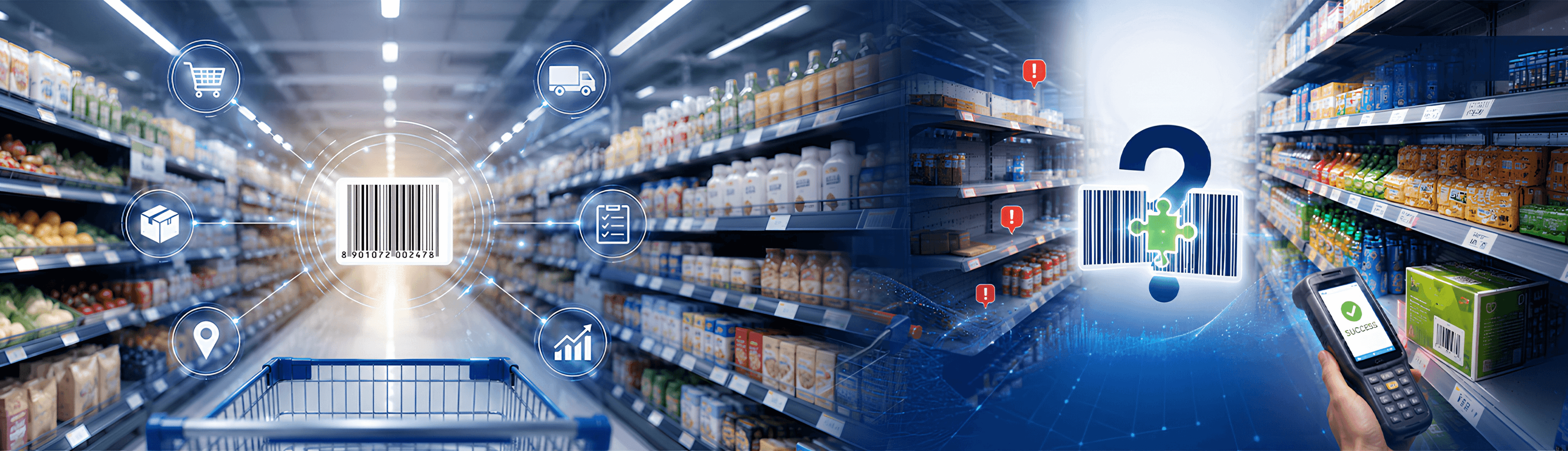

A customer walks into a store looking for a product that the retailer's system shows as available. The shelf says it is unavailable. The store team checks the stockroom; it is available. The warehouse report shows inventory. The replenishment team believes the stock has already been dispatched. At this point, the problem is no longer inventory; it is visibility. Retailers deal with these situations more often than they would like. Products appear available in reports but remain unavailable on shelves. Replenishment gets delayed, stock counts stop matching reality, and while these issues are often blamed on forecasting or operations, the root cause can be much simpler: products are not being identified consistently across the retail network. As retail operations become more connected, product identification is playing a bigger role in keeping inventory accurate and visible.
Most retailers today already use sophisticated tools to monitor stock movement. Yet inventory gaps still appear. One common reason is that products are recorded differently across stores, warehouses, suppliers, and retail systems. A product may move physically, but if the information attached to it is inconsistent, stock visibility starts breaking down.
This creates familiar challenges:
Many retailers focus heavily on improving inventory management processes, but discover that accurate product identification is just as important for maintaining stock visibility.
Retail inventory depends on products being recognised consistently at every touchpoint. Receiving, storage, replenishment, billing, and stock transfers all rely on product information being accurate and aligned. When products are identified inconsistently, inventory records begin drifting apart. This is where many retailers see problems with retail inventory management. Stock may physically exist within the network, but teams struggle to determine exactly where it is or whether it is available for sale. The issue becomes more visible as product catalogues expand and retail operations scale across multiple locations.
For retailers, these gaps often create what is commonly known as "phantom inventory", stock that appears available in the system but cannot be located quickly. Customers see empty shelves, store teams spend time investigating discrepancies, and replenishment decisions get delayed because inventory records cannot be trusted fully.
Retail operations are becoming increasingly dependent on accurate stock visibility. Customers expect products to be available when systems show them as available. Retailers want faster replenishment, better forecasting, and fewer stock discrepancies. This is one reason businesses are paying closer attention to retail inventory management foundations rather than focusing only on forecasting or reporting tools. Better product identification helps create cleaner inventory records, fewer stock mismatches, and improved visibility across the network.
Before investing in new technologies or changing replenishment strategies, retailers should evaluate the quality of the product information flowing through their operations. It is worth checking whether the same product is being identified consistently across stores, warehouses, supplier records, and inventory systems. Even a small mismatch can create duplicate records, inaccurate stock visibility, and replenishment delays.
Addressing these issues early helps build a stronger foundation for inventory accuracy. Once product information is consistent, forecasting, replenishment, and stock tracking become far more reliable because every system is working with the same product data.
Customers do not see inventory records; they see shelves. When a product is unavailable despite showing in stock internally, the shopping experience suffers. Most customers do not wait for a replenishment cycle to fix the problem. They simply choose an alternative product. Over time, repeated availability issues affect customer confidence, sales performance, and retailer relationships with suppliers.
Inventory gaps often happen when product information is inconsistent across stores, warehouses, and retail systems.
It helps ensure products are recognised consistently across receiving, storage, replenishment, and sales processes.
No. Technology depends on accurate and consistent product information to provide reliable inventory visibility.
Conflicting product records and poor visibility can delay replenishment decisions even when inventory exists.
Improving product identification and maintaining consistent product data across the retail network.
Your email address will not be published. Required fields are marked *